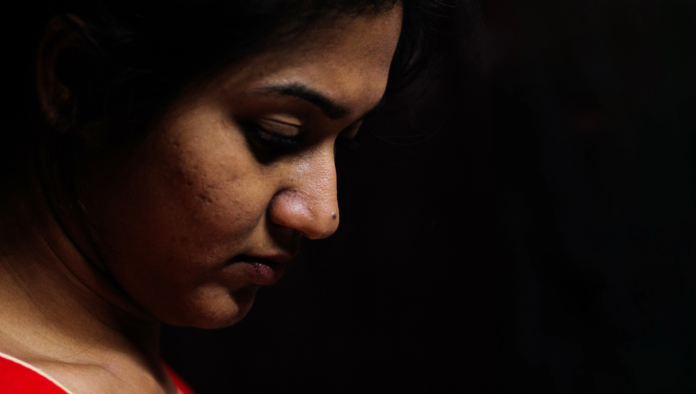


When a patriarchal family system can’t control the new woman who becomes part of it through marriage, her identity can get organised around the narrative that she is mad, hysterical, overemotional, irrational, lazy, sensitive, prone to falling sick and so on. What gets elided in this narrative is the psychosocial pathology inherent in much of the Indian family system that pushes women to the brink.
The way many family systems are structured allows the survival of foreign women in the family hierarchy only when they collude with its oppressive expectations and stringent, suffocating norms. Women in many of these families also need to compete with each other and conspicuously produce evidence of their loyalty to the family system and dissemination of its values, traditions, and norms.
Psycho-Somatic or Psycho-Social?
When I listen to my female clients in the therapy room and reflect on my own experiences, I realize that when open protest is impossible or comes with severe repercussions, women’s bodies become the carrier of many mysterious psychosomatic illnesses – their bodies articulating what can’t be expressed in speech.
They come to the session tired and fed up with their psychosomatic symptoms- hormonal imbalances, unrelenting migraines, indigestion, and chronic fatigue, and when we trace the trajectory and particular histories of these illnesses, what we find is that many of these troubles started when they got married. For some of them, the troubles began much before – when they were officially betrothed, and the family of the husband co-opted them – ab toh yeh hamari amanat hain (now she is ours for safekeeping ).
A client discussing her mother in law’s insistence that she follows the religious rituals of her husband’s family to perfection – many of which are incompatible with the client’s belief system and lifestyle – notices that her hormonal imbalance and gut related issues began soon after her rishta got fixed.
Its beginnings coincided with her husband’s mother forcing her to visit their family temple in another city and comply with their rather strict rules during the visit.
The Cost of Becoming a Perfect Woman.
Women, despite our supposed emancipation, are still very much constrained by some of the entrenched oppressive familial norms that have continued to dominate much of the Indian psyche. The religious myths that abound in the Indian collective psyche put tremendous pressure on women to toe the line. They are afraid to be the kaleshi bahu (troublemaker daughter-in-law) that broke the household – internalised shame and guilt haunting them at the prospect of being that kind of bahu.
This bahu is in stark contrast to the mythic Sita, who quietly followed her husband to the forest for an exile of fourteen years and later again quietly retired to the forest when her husband discarded her because of aspersions cast on her character. Only in the end, perhaps fed up by the incessant demands of her husband and society to prove her character’s chastity and worthiness, she rebelled and beseeched the mother earth to give her permanent asylum in the womb, choosing oblivion over marriage, peace over husband and children.
It might be important to examine Ram’s actions to understand romantic heterosexual relationships in India. Arshia Sattar writes in the introduction to her book, Lost Loves: Exploring Rama’s Anguish, “…I am convinced that the way to a more complete understanding of the Ramayana, especially for contemporary women, has to be through an inclusion rather than a rejection of Rama and his shocking behaviour” (Sattar, 2019, 3). Rama, despite being hailed as the maryada purushottam, engaged in many objectionable acts, including giving up on his pregnant wife and exiling her to the forest. Maybe understanding what led him to act in such a cruel way (and not exonerating it) may shed light on the intricacies of human relations — despite our sincere love for our beloved, we may many a time, like Ram, injure them grievously.
According to Sattar (2019), Ram is deeply embarrassed by his father’s disproportionate attachment to Kaikeyi, which led to his banishment. Sattar (2029, 22) writes, “Rama’s agitation at Shurpanakha’s unbridled sexuality could well be the result of his resentment towards his stepmother Kaikeyi, whose sexual favours had kept Dasharatha in such thrall that he was unable to prevent Rama’s banishment from the kingdom… Ram’s displaced anger finds its object in the person of the besotted rakshasi and, ironically, triggers the events that lead to Sita being abducted.”
Ram’s rejection of Sita [based on doubts about her chastity] after the fall of Ravana could be an expression of his overwhelming fear that people would gossip about him and equate him with his father, who was so much in love with his youngest wife that he sent his rightful heir to the forest and faced scandal. Attachment to women had become painfully knotted in Ram’s psyche as too much attachment to them could become a source of public censure and thu-thu (derision). Ram’s fear of being judged like his father – a man not able to contain his love for a woman – makes him treat Sita more harshly than he would have otherwise (Sattar, 2019, 24).
From External Oppressions to Internalized Shame
Different parts of women are in conflict with each other, and the cognitive dissonance and emotional incongruence arising from it cause them much suffering. Women want to break free from the constraining norms of marriage but are guilt-tripped often by their partners, sometimes even by their own families, for having too many complaints, not being adjusted enough and not being grateful enough for the freedoms allowed to them in their sasural (in-laws’ house)in comparison to many other women’s sasurals and so on.
These accusations with time become internalised so that many of them talk about themselves like their partners do – chiding themselves for being too needy and sensitive, not being thick skinned – locating all the trouble inside themselves rather than outside where it belongs.
They would blame themselves for getting worked up when their boundaries are repeatedly crossed – wishing they were not so triggered by the very triggering real things that people do to them. For some of them, a great deal of shame gets internalised: their failure to be the adjusting, always happy and chirpy bahu is experienced as a personal failure – proving their character falls short. When they are repeatedly told, “Why can’t you do it when she can do it?”, despite the rational part in them knowing it is unfair to compare, it can create guilt and shame.
I have observed that sometimes the woman withdraws and becomes quiet when she realises there is no point trying to make her husband and his family understand. Her protective silence could also trigger anger and backlash as it is perceived as a subtle affront to the family’s patriarchal authority. She needs to be perpetually smiling, laughing and joking.
In a session with a female client, discussing her struggles of being invisibilised and feeling unheard by her in-laws every time she tried bringing up her issues with them, I quickly began giving her advice, which was unlike me. Later in the session, I realised that I was enacting our mutual helplessness at not being able to do anything concrete to resolve these perennial issues. Unable to bear her helplessness, I started giving her advice, most of which she already knew. However, acting on that advice most likely will come with repercussions. When I realised what I was doing, I took a pause and apologised to her for inundating her with unnecessary advice. I told her that it was difficult for me to stay with her helplessness because I was also experiencing it. Her eyes almost teared up when she heard this.
The loss of the self is the price many women have to pay for entry and consolidation of their status in the husband’s family. When she protests, she is labelled as hysterical and mad. If these women are on psychiatric medication for mood disorders like anxiety and depression, it is portrayed as a kami/lack and used as further proof that the fault lies with them.
Their real suffering and protests are then framed as originating from within themselves thwarting any real reflection on how the family system [and the larger social system] is the site of their oppression.
Sometimes, to ease the guilt of my female clients, I tell them with a touch of humour that even if god had sent anapsara (nymph) from swarg (heaven), the husband’s family system would still find some fault with them. We both laugh, and it eases the guilt for being different. Being different doesn’t necessarily mean they are wrong.
Psychiatrists and psychotherapists unwittingly reinforce the idea that they are diseased – pathologising their symptoms as proof of their culpability. We and the social media inundate them with self-regulation skills, breathing exercises, mental health podcasts and so on — overwhelming an already overloaded nervous system with more things to do. By doing this, we tragically strengthen the idea that if they just do enough, everything will be fine, again placing the disorder inside them rather than in the micro and macro cultural systems.
For many women, then, the only path left to protect themselves amidst the cacophony of contradictory demands placed on them is to leave their respective marriages. However, in reality, only a few women have this choice. Many can’t access this dream, even if the fantasy of it keeps them going. Real and imagined fears and dangers keep them stuck – financial dependence, social ostracism, starting all over again, dependent young children, and fear of having no one in one’s old age.
Sometimes when I listen to a client verbalising their visceral frustration at what they’ve been made to do and say, a part of me quietly wonders how long they will survive – will they break or will the marriage break? It is disheartening to realise in one’s bones how the two, many a time, are inherently opposed to each other.
The Mother/Wife Conundrum
When talking about marriage in the Indian context, it is important to talk about the mother-son relationship. For many mothers, it is their sons who are their partners – carriers of their unfulfilled dreams and yearnings as well as their unmetabolized rage and disavowed grief. Their rage, grief, yearnings and dreams can significantly affect their adult heterosexual son’s romantic relationships.
The male child indebted to the mother for her multiple, larger-than-life sacrifices cannot afford to see her as an ordinary, complex human being. He can consciously experience her as the ‘good object’ only, feeling a deep sense of gratitude and love for her. What gets split off is his unconscious rage and hatred of his mother, which is as powerful (if not more) than his love. This rage and hatred, many a time, gets projected onto his female paramours and/or spouse, significantly shaping his heterosexual romantic relationships. This particular understanding is derived from the object relations school of thought, part of psychoanalytic theory emphasising the use of mechanisms like splitting used by the infant that we carry into adulthood.
At the unconscious level, psychically the male adult child (and husband) might be extremely frightened of being, yet again, engulfed by the overwhelming presence of the woman – this time his spouse triggers his unconscious fears of engulfment that perhaps originated in the mother-son dyad embedded in the larger sociocultural context.
What comes to mind is the concept of maternal enthrallment coined by the late psychoanalyst, Sudhir Kakar. Maternal enthrallment refers to the fierce and often unconscious bond between a mother and her son, which can markedly impact the son’s adult relationships and attitudes towards women. It is characterized by a complex interaction of attraction, deep gratitude, love and desire for closeness with the mother alongside often unconscious split-off rage, hatred and desire for separation from the mother.
The new female entrant could also be perceived as a danger by the husband’s family because it could threaten their central role in their adult son’s life. This new participant in the husband’s family system can unwittingly unconsciously get associated with the ‘not me’ parts of the family system, as explained by Sullivan’s work on Interpersonal Psychoanalysis tradition.
What the family members have denied in themselves and not allowed to consciously exist in the system is then projected onto the new female entrant – her difference becoming the hook on which all the intolerable ‘not me’ parts get projected; she becomes the carrier of all the otherness/badness that they disavow in themselves – vividly picturing her as the villain of the family.
She becomes the de facto ‘bad object’, similar to the mother who is consciously experienced as the ‘good object’ only – the complexities of both women’s respective personhoods stripped away. Both are fixed in roles that can easily eclipse their entire individual identities. A good mother is perpetually a good mother, performing her role to perfection into death itself.
When I hear my aunt valorising that she can’t leave dirty dishes in the sink at night, even when quite unwell – a chore she has been religiously doing for more than four decades now – I feel a particular sadness in me. I wonder wistfully what will happen if one day she refuses to wash them. I wonder what it does to the other women in our home, what pressures it puts on them.
Arshia Sattar suggests in Lost Loves (2019) that Sita rejected Ram at the end because she could not reconcile the Ram she fell in love with during their exile in the forest (before her abduction) with the Ram, the warrior and king, for whom his Kshatriya dharma, kingly duties and the reputation of his clan were foremost. The memories of her idyllic time with the gentle Ram of the forests gave her strength to bear her separation from him in Ravana’s palace and Valimiki’s hermitage. Those memories informed her imagination- told her what was possible. Her refusal in the end was also a rejection of the patriarchal order that prioritised kingship, lineage and warrior dharma over an ethic of care.
No Easy Solutions
Women’s protests symbolise their refusal to bow down to a system attempting to mould them in convoluted inauthentic shapes. Their protests are not always linear, conscious and/or verbal and yet continue to leave an indelible mark on our individual and collective psyches. When I meet these women in the therapy room and on the street, I am privileged to get a peek into their inner worlds and their imaginings of an alternate universe based on an ethic of mutual care, play, rest and reciprocity. The themes I grapple with don’t have easy resolutions. As practitioners and women, it is important for us to sit with these difficulties so that we don’t inadvertently pathologise women’s very real suffering and weaponise it against them.
References
Kakar, S. (2012). The Inner World: A Psychoanalytic Study of Childhood and Society in India (4th ed.). Oxford University Press
Sattar, A. (2019). Lost Loves: Exploring Rama’s Anguish. HarperCollins India.

Roshini Behal
Roshini Behal is a psychotherapist interested in the inner worlds of women and how they are shaped by various systems -both traditional and modern. Through her writing, she wants to subvert the conventional understandings of a woman’s personhood giving voice to the subterranean and alternative voices of women not co-opted by systems of oppression.