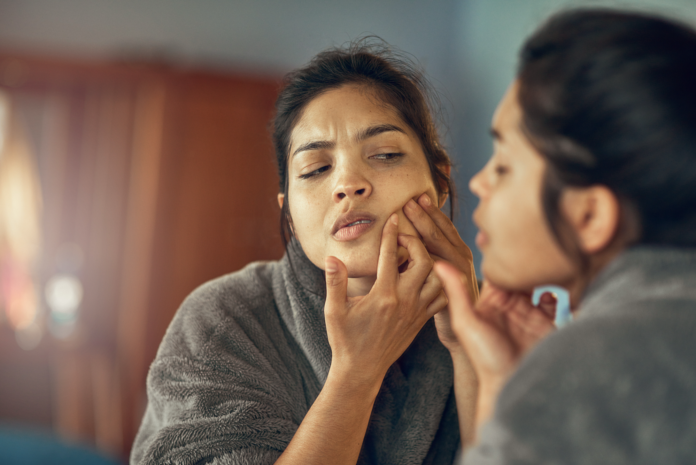

Acne, eczema, hair loss – these are often treated as dermatological conditions, located neatly on the surface of the body and managed through creams, medications and clinical routines. The assumption is straightforward that if the symptoms appear on the skin, the problem must lie within it. But this assumption, while convenient, may be fundamentally incomplete.
What if the skin is not merely reacting, but communicating?
This question sits at the heart of psychodermatology, a field that examines the relationship between psychological processes and skin conditions. But, to view psychodermatology simply as a sub-specialty within medicine would be to miss its deeper implication. It does not just connect mind and body but also challenges the very separation between them.
Modern dermatological practice often operates within a biomedical framework that prioritizes visible symptoms and measurable pathology. Conditions are diagnosed, categorised, and treated through a lens that helps gain clarity and control. While this approach has undeniable value, it can also narrow the scope of understanding.
When skin conditions are reduced to biological dysfunction, the emotional and social realities that surround them are frequently overlooked.
Stress-induced acne, flare-ups of eczema during periods of anxiety, or sudden hair loss following prolonged distress are not uncommon experiences.
Research in psychoneuroimmunology has long suggested that psychological stress can influence immune responses, inflammation, and skin reactivity (Arck et al., 2006). Similarly, a study done by Gupta & Gupta (2003) resulted in clinical observations that have shown that dermatological conditions often coexist with anxiety, depression, or social withdrawal (Gupta & Gupta, 2003). To understand better, let’s understand with an example wherein a student is developing acne before examinations, or an individual experiencing hair fall during prolonged stress, these are not isolated anomalies but familiar patterns.
Yet, despite this growing body of evidence, treatment approaches often remain symptom-focused. The skin is addressed, but the context in which it exists is left largely unexplored.
Part of the difficulty lies in how suffering itself is conceptualised. Within dominant medical frameworks, distress is frequently located within the individual body, as a dysfunction to be corrected. Psychodermatology complicates this narrative by suggesting that the body does not only malfunction but it also responds.
In this sense, the skin becomes a site where internal states and external pressures intersect. It reflects not only physiological processes but also lived experience.
Consider the social and cultural dimensions that shape how the skin is perceived. In many South Asian contexts, appearance carries significant social weight. Clear skin is often associated with discipline, desirability, and even moral worth, while visible skin conditions can attract stigma, unsolicited advice, or subtle exclusion. The pressure to conform to aesthetic norms, whether through fairness standards, cosmetic practices, or digital filters often creates an environment where the skin is constantly evaluated.
Within such a context, a skin condition is not simply a medical issue rather it becomes a social experience.
The distress associated with it is not only about physical discomfort, but about visibility, judgement, and identity. To treat the skin without acknowledging these layers is to address only a fraction of the experience.
There is also an economic and structural dimension that requires attention. The rise of the cosmetic and skincare industry, coupled with the promise of quick fixes, has reinforced the idea that skin problems can and should be resolved swiftly. Products, procedures, and prescriptions are offered as solutions, often without engaging with the conditions that contribute to the problem in the first place.
This is not to dismiss medical treatment, but to question its sufficiency when used in isolation.
What is left unaddressed when treatment focuses solely on the surface? What conversations are avoided when distress is translated into diagnosis without context?
Psychodermatology invites a different approach, not by rejecting biological explanations, but by situating them within a broader framework. It recognises that the skin is embedded within a person, and that person within a social world. Emotional distress, environmental stressors, and cultural expectations are not peripheral factors, rather they are central to understanding why certain conditions emerge, persist, or intensify.
To engage with the skin, then, is also to engage with the person.
This shift in perspective requires moving away from reductionist thinking, whether biological, psychological, or social and towards a more integrated understanding of health. It asks practitioners to consider not only what is visible, but what is experienced. It asks whether recurring symptoms might be signaling something that cannot be captured through clinical examination alone.
And perhaps more importantly, it asks whether the goal of treatment is only the removal of symptoms, or the understanding of their meaning.
The skin, often treated as a boundary, may in fact be one of the most expressive interfaces between the individual and their environment. It reacts, adapts, and at times, reveals. To ignore this expressive dimension is to overlook an important aspect of how the body communicates.
Psychodermatology, in this sense, does more than bridge disciplines. It unsettles the assumption that the mind and body can be neatly separated, and that suffering can be fully understood through isolated systems.
Perhaps what needs reconsideration is not simply how skin conditions are treated, but how they are interpreted.
Because when the skin speaks, it may not be asking to be silenced.
It may be asking to be understood.
References
● Arck, P., Slominski, A., Theoharides, T., Peters, E., & Paus, R. (2006). Neuroimmunology of stress: Skin takes center stage. Journal of Investigative Dermatology.
● Gupta, M. A., & Gupta, A. K. (2003). Psychiatric and psychological co-morbidity in patients with dermatologic disorders. American Journal of Clinical Dermatology.
● Koo, J., & Lee, C. (2003). Psychocutaneous medicine. Journal of the American Academy of Dermatology.
● Dantzer, R., O’Connor, J., Freund, G., Johnson, R., & Kelley, K. (2008). From inflammation to sickness and depression. Nature Reviews Neuroscience.

Majida Jawria
Majida Jawria is a psychology researcher and educator with five peer-reviewed publications in journals including Scopus-indexed Taylor & Francis and Psychology Health & Medicine. Sheholds an MSc in Psychology and a PG Diploma in Guidance and Counselling from Jamia MilliaIslamia. Her work focuses on translating psychological research for everyday understanding.