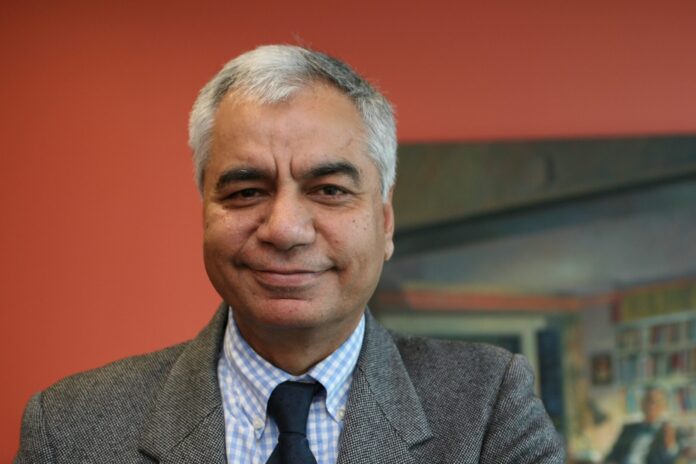


Dinesh Bhugra is a leading voice in social and cultural psychiatry. He is Emeritus Professor of Mental Health and Cultural Diversity at King’s College London and has served as president of the Royal College of Psychiatrists, the British Medical Association, and the World Psychiatric Association. His many honors include being named a Commander of the Order of the British Empire (CBE) for services to psychiatry and receiving the Yves Pelicier Prize for his contributions to social psychiatry.
A prolific scholar who has authored or edited more than 30 books, Bhugra is also a clinician and a longtime advocate for patients’ rights to be heard and understood on their own terms. Throughout his career, he has challenged psychiatry to look beyond symptoms and diagnoses and to attend more closely to culture, community, social conditions, and the lived realities of human suffering.
In this interview, we discuss how mental health is shaped by interconnected social, political, geographical, and commercial forces, from poverty and migration to corporate lobbying and the conditions in which people work and live. Bhugra considers what clinicians can learn by listening to patients’ own explanations of their experiences, and why symptoms may become more livable when people have meaningful relationships, work, security, and a sense of belonging. We also discuss the psychiatrization of society, the limits of exporting Western psychiatric categories across cultures, and the question of who gets to decide what counts as normal or pathological.
The transcript below has been edited for length and clarity. Listen to the audio of the interview here.
Ayurdhi Dhar: I want to begin with your newer work on public mental health. People have written about social determinants—how things like discrimination, violence, poverty, casteism, and oppression can influence a person’s mental health—but they tend to collapse the social into the individual.
For example, they talk about escalating care for farmers who are killing themselves because they are ridden with debt. What’s the solution? Let’s give them antidepressants.
Your writings don’t do this. At no point did I find a collapse of the social into the individual. Taking a public mental health approach, over the course of your career, what have you found to be the major causes that lead people to have poor mental health?
Dinesh Bhugra: There are a lot of factors, starting with biological factors. But more importantly, from a cultural perspective, it is also about how we are brought up, how we learn to protect ourselves and those we love. It’s also about social factors over which sometimes we have no control.
For example, poverty, unemployment, housing, overcrowding, lack of access to green spaces. We saw part of that during the pandemic, when people were very isolated and couldn’t communicate or move around.
Social determinants are important, but what we forget is that the world is interconnected. Social determinants in one country are likely to be affected by factors like wars and conflicts or climate change, which may lead to migration. You move from smaller places to bigger places, with increased urbanization and overcrowding.
I have become very interested in the concept of geopsychiatry, which includes not only wars, conflicts, and climate change, but also natural disasters—what that means and how that affects people’s mental health and well-being. There are other interrelated determinants that we have to look at.
One is political determinants of mental health—how society, through its politicians, decides who gets detained against their will, who gets treated against their will, and what the implications are. Politicians decide how much money gets spent on health, mental health, social care, public health, prevention, etc. The third, increasingly important factor is commercial determinants.
We’ve known for about 80 years that tobacco causes lung cancer, and it took politicians about 60-plus years to change the laws and make demands of tobacco companies—for example, requiring messages on cigarette packets. The same companies have now gone into food production, ultra-processed food. It’s cheap, attractive, but it can be quite addictive. It’s producing a lot of obesity, and we know obesity produces diabetes, osteoarthritis, increased chances of various kinds of cancer, which then affects mental health and well-being.
It’s all related, and these commercial determinants are doing three things. Firstly, they use messaging in a way that is attractive to people because it’s cheap and cheerful. They’re also using strategies in terms of lobbying and donations to political parties to make sure politicians don’t respond in the same way they responded to tobacco companies. Thirdly, where the food is manufactured, where these commercial products are manufactured, there is very little or very limited control of the working environment. The workers are then getting physical illnesses and psychiatric disorders.
The patient is at the core of it, but they’re surrounded by family, community, society, culture, and at each level these determinants play a role. If we’re not looking at those factors, then we are just treating the endpoint—the patient.
It’s important to put the person in the context of what else is going on in their life. Quite often, you see in clinical practice that most patients can live with their symptoms, provided they have a job, money in their pocket, a roof over their heads, relationships. But many a time, we focus on symptom reduction.
Dhar: Sarah Pinto has a beautiful book, Daughters of Parvati, about madness and women in India. I love the example of the woman who hears voices, but her family is fine with it because she’s a functional homemaker and she’s fulfilling her role as a person in this familial unit. They don’t find it a big deal that she’s hearing voices. Making meaning around one’s “symptoms” is not just a personal thing; it’s also the family. If the family panicked and said, “My God, you cannot be hearing voices!” even if the individual was calm, that would have been problematic.
I asked you about things that endanger our mental health, but what have you seen to be the protective factors? What protects people?
Bhugra: I think the tragedy for a very long time, certainly in the West, has been that we’ve separated mental health out of physical health, as if mind and body don’t talk to each other. In India, when people go to see a Hakeem or a homeopath or an Ayurvedic doctor, they would look at the person and the interaction. Then they look at the diet, the environment, and what else is going on in their lives.
A big lesson has been that different cultures see mental illness and distress in very different ways, and we are in danger of imposing Western dichotomous models in assessment, diagnosis, and management. We need to go beyond that.
Dhar: Your social world not only decides how you express distress, but also what counts as distress.
Bhugra: What counts as distress, where you seek help, how you see it, what your explanatory models are. I used to see a patient who had had schizophrenia since the age of 15. I started looking after him when he reached adulthood. I got a phone call from the father, who said, “You tell us that he’s got schizophrenia, and yes, he’s doing well on this medication, but we think he’s possessed. What do you think?”
I said, “Look, I don’t believe in it. But if that’s what you feel, then I can respect that.”
I put the family in touch with the hospital chaplain, and between the family and the chaplain, whatever they did, I have no idea. But last I heard, the patient had got married, had children, had a job. For me, that’s a success story, and that goes back to staying with the symptoms but getting other things sorted.
Dhar: That’s our many pathways to healing. There are many ways human beings break, and thus there are many ways they are put together. For me, the biggest problem with my own discipline, which is psychology, has been the hubris of assuming that we are the only people who can address human suffering, that it was never recognized before us, and that people were just lost.
Thinking of an average Joe in the U.S. who is dealing with loneliness, unemployment, inflation, and has feelings of extreme sadness and thoughts of self-harm in response to all of this: What is a public mental health approach? What kind of advice and solutions does it offer when we can see that the problems are so systemic? What would we, as clinicians, want to do for this person?
Bhugra: There are several strategies. There are differences between egocentric societies and sociocentric societies, so one size will not fit all. There have been some fascinating examples in Zimbabwe. What they did was set up Friendship Benches. In the UK, because of the boat migrants, they have set up what’s called a “grandmother’s table,” where migrants come together to do some painting and things. That’s one way of sharing.
The biggest thing is to try to find what’s available locally and how it works. Let me give you another example of what’s called social prescribing in the UK. Groups of people come together, whether it is for photography, gardening, music, or reading. What that means is that you’re getting away from your loneliness, meeting others. It’s been shown that people who join this—a lot of them don’t then need psychotherapy because they’ve found their balance.
There was an interesting example from Pakistan a few years ago where they trained schoolchildren to identify people with psychosis and epilepsy in their villages. They would go and tell their teacher, who would do a structured screening, involve the community mental health worker, and then scale it up to a general practitioner or specialist. You could argue that that’s the use of cheap labor, but it’s also equally important that the community is taking responsibility.
Going back to your lonely person in the U.S., there have to be community links, whether it’s a religious organization, a community organization, a physical activity, or something else where they can reach out to people. We clinicians need to get out of our comfort zones of sitting in the wards and work with community organizations. We work with Black church leaders because I don’t understand what speaking in tongues means. If I saw somebody in a clinic, I might erroneously label it as psychosis. So I need to know from the religious leaders what is normal and what’s not.
Equally importantly, when we did some work with Punjabi women in West London 30-plus years ago, there’s no word for depression in Punjabi or Hindi, but that does not mean people don’t suffer. They recognized the symptoms. When we asked, “What causes it?” they said, “Oh, this is part of life’s ups and downs. It’s not a medical problem.”
We asked, “What would you do?” They said, “We’ll go to the temple or the mosque or the gurdwara.” Why can’t a community psychiatric nurse pop into these religious places, so anyone who needs help can go and talk to him or her in a confidential manner?
Dhar: I agree with the importance of community mobilization to validate distress and then respond to it. My one worry has been looking at what happens to rural community mental health workers. There is some wonderful work done by Ranganathan and Kottai, and Jain and Jadhav. The danger often is that whole villages get identified as sites of disorder. You have a psychiatrist who comes once a year, and the job of the community mental health worker becomes to threaten people: “Keep eating your medicine or I’ll tell the psychiatrist.” It’s a punishment.
With psychopharmaceuticals, we know that in the short term they can be useful for some people. However, many people also respond badly. There’s akathisia, suicidal ideation, extreme sedation. For a person who works on their computer, maybe they can manage a little sedation. But for a rural farmer in Ghana who has to walk miles to get water, if you’re sedated because of an antipsychotic, it is death. So, for me, a huge problem is that task shifting and community mental health workers look good on paper, but the practice harms a lot of people.
Bhugra: You’re absolutely right. It’s important to remember that one size doesn’t fit all. One of the big challenges is that the West doesn’t have all the answers. I know psychiatrists in India, for example, who see 200 patients a day.
It’s unacceptable because you’re spending two minutes. You’re just looking at the symptoms, and you’re not even looking at the patient.
Dhar: You have written about the psychiatrization of society with China Mills. Could you tell us more?
Bhugra: What’s happened, certainly in the UK in the last 10 years, is that every normal human response has been turned into a mental illness. That’s what psychiatrization is: normal human emotions are being medicalized and psychiatrized. That’s not to under-emphasize that people are suffering. For example, increasing numbers of people are talking about suffering from PTSD. Yes, there is stress. There may have been a traumatic event. But PTSD means something very different.
Before we started, you talked about concept creep. That’s what’s happened: the concept has crept into creating conditions.
You can’t have a bad day. We used to say, “I got out of the wrong side of bed today, so I’m having a bad day.” These days, it’s “I’m depressed,” which is also fine. But what it does is underplay the seriousness of other psychiatric disorders, like schizophrenia or bipolar disorder.
Psychiatrization means that somehow your problem will then be sorted by medication or therapy. In a way, that makes people feel less stigmatized. But it also means that serious illnesses get ignored.
Dhar: When I taught college students in the U.S., at one point I observed that sometimes 60% of my classroom had some psychiatric diagnosis. These were just kids—bright, caring kids—and they were in pain. They were suffering, isolated, and didn’t know how to become friends with each other. To make sense of that pain, they were clinging to multiple diagnoses, trying to find a place to belong. Once they latched onto a diagnosis, it clawed its way into their identity.
You can wake up on the wrong side of the bed, and tomorrow you can wake up on the right side. But if you say, “I’m depressed,” then suddenly you think there’s something chronically wrong inside you. It really shapes your experience of your own pain and can worsen it.
Bhugra: That part of psychiatrization has led to an increase in gender dysphoria and eating disorders. Something I’ve become interested in is the question of micro-identities. We all have multiple micro-identities to do with gender and sexual orientation, religion, disability, etc. Quite often, in that mosaic of identities, one identity takes precedence over everything else—where the light is shining, as I call it.
It may be that your sexual orientation becomes more important, or your depression becomes more important. You are not a person who’s depressed; you’re a depressed person. Those prioritizations create difficulties, not only in the context of where you seek help and who takes responsibility, but your idea of community changes.
The more connected we are on social media, the lonelier we are. And that loneliness means that I’m not a lonely person; I am a depressed person.
Dhar: You write that a huge part of your work has been about listening to patients and understanding their own stories. In all these years, what has been your big takeaway from what happens when clinicians actually sit down and understand people’s own perspectives on why they are suffering and what will help them?
Bhugra: You learn that patients actually give you the diagnosis. They tell you what’s going on, and it’s the patience of the clinician to try to make sense of the patient’s experience that is absolutely vital. Patients can live with their symptoms as long as they have a job, money in their pocket, relationships, etc.
We don’t teach medical students or trainee doctors how to advocate. I think that’s a very important skill that we need to teach, and it’s not the same style of advocacy in every setting. Advocating to a community organization is going to be very different from advocating to funders, politicians, policymakers, or civil servants. You need different skill sets, but you can advocate. That’s been a wonderful piece of learning.
Dhar: This listening to people’s lived experience has informed your understanding of delusions. When I was an undergraduate, I was taught that delusions are nonsense, noise. You talk about a symbol-based model of delusion, where the features of psychosis are an interplay between culture and subjective experience.
This means delusions might be the person’s attempt to make meaning out of what they’re experiencing. Can you tell us more about that, and about the dangers if we just shut it down and consider it garbage?
Bhugra: Do you read novels?
Dhar: Yes.
Bhugra: Look out for Amitav Ghosh’s latest, called Ghost-Eye. The book is about a three-year-old child who can remember her previous life. She has very vivid memories, and there’s a whole host of stories around it. When is a delusion not a delusion? She has these memories, but she’s three years old. How can a three-year-old have memories of what had gone on when she wasn’t born?
That brought to my mind what most of us have had: odd experiences.
You’re walking, and you hear your name being called. You look back, and there’s nobody there. You may see somebody and think, “Oh, but they were dead.” Is it a ghost, or is it just my imagination, or is it something else? There are those kinds of experiences, and for most people it happens once or twice, and you forget about it. For people with psychosis and schizophrenia, these are persistent experiences.
The question is, what is normal? Would you call it normal if it’s persisting? Is it the duration, the severity, the impact on the person or on others around the person? Quite often there are experiences we would call spiritual or religious experiences, like possession states. What does that mean? Culture defines what is normal and what’s not, what’s deviant and what’s not.
Part of the challenge for clinicians is to take culture into account, to be humble about it, to try to understand how cultures see those experiences before we start pathologizing and putting them in the DSM or ICD. Part of the challenge in diagnosis is that we need to be very clear what diagnosis is for. Is it for clinicians, to make us feel better that we’re doing something? Is it about this whole idea of normality versus abnormality? What is seen as pathological or not, and who defines it?
All these experiences, like out-of-body experiences, are psychiatric symptoms—but are they really? How do we say that this is abnormal and this level of abnormality is unacceptable? If you score above seven, you’re pathological, but if you’re six and a half, you’re not.
Arthur Kleinman has written about the category fallacy: that you’re imposing categories developed in one culture onto another and pathologizing.
I’ve seen that in some of my own research. We used the Eating Attitudes Test-26, or EAT-26, which was developed in Canada, and we used the Hindi version. We translated it into Hindi and back-translated and retranslated and did all the things we were expected to do. We gave it to 580 teenage girls in North India and discovered that 29% scored above the threshold on the questionnaire.
This is not possible.
We looked at the questions that were causing problems, questions such as, “Food controls my life.” So, if you’re poor and you don’t know where your next meal may be coming from, food will control your life.
Another question was, “I cut my food into small pieces.” If you’re eating Indian food…
It was a major lesson: don’t blindly use those questionnaires. Look at the person in the context of employment, community, family, and political structures.
This interview first appeared in Mad in America, and can be read and heard here.
It has been re-produced here in its entirety.