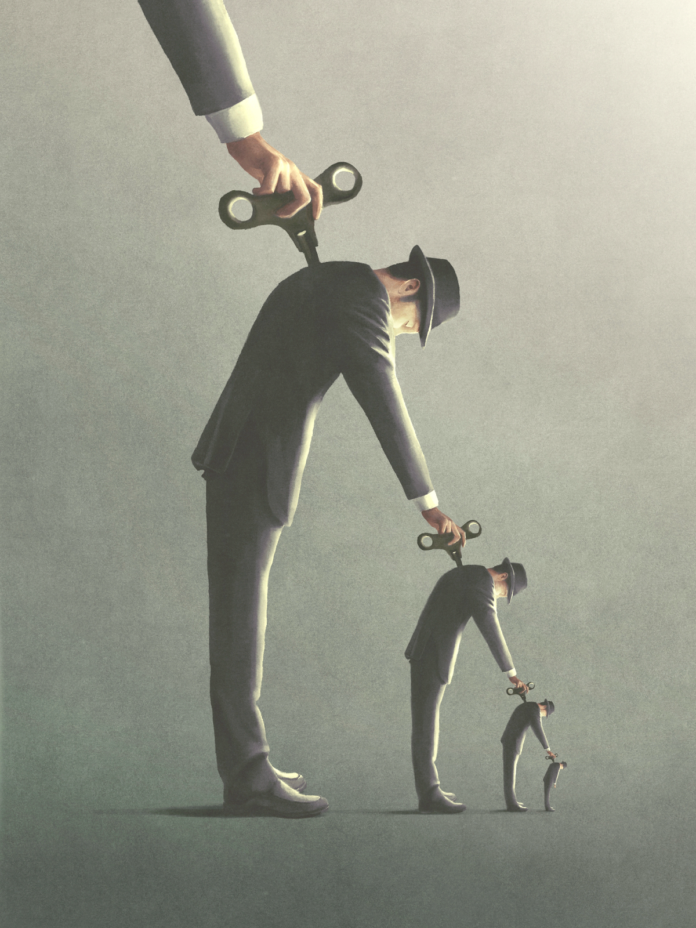


Social psychology has studied human behaviour for a long time but it has mostly ignored how capitalism shapes how people think about themselves and the society. A few researchers have looked at it but it has never been a central focus of the field, and this is not just by chance but a series of events discussed in this paper.
Money, Mind, and Capitalism
Let’s start with the idea of Capitalism. Although it is a broad term with different meanings across time, place, and people, its core ideas come from the work of Marx who understood,
“Capitalism as an economic system predicated upon private ownership of the means of production, wage labor, and the pursuit of profit through competitive markets.”
Building on this, a large number of scholars agree on the main features of capitalism—profit motive, market competition, and private property. But Capitalism does more than organise markets. It also shapes social values and ways of thinking. Capitalism works like a cultural syndrome that promotes certain beliefs, goals, and behaviours, and these influence how people understand themselves. The authors write,
“A “cultural syndrome” encapsulates a unified cluster of beliefs, values, and behavioral tendencies prevalent within a specific cultural group.”
This can be seen clearly in European history. For a long time, life in Europe was shaped by scarcity and struggle over limited resources. In this setting, people who could gain and control wealth had better chances of survival and status. Over time, this made wealth, competition, and accumulation highly valued while qualities like care or cooperation mattered less if they did not lead to advantage.
These values later also supported colonial practices. Seeing wealth and power as signs of superiority made it easier to justify taking land, labour, and resources from other societies. Groups that believed in competition, control, and superiority emerged as successful. As these groups became rich and powerful, they were able to shape knowledge through schools, governments, and work places. Their values slowly became natural and normal. Their ideas about success, hard work, and individual achievement became common sense. These values did not stay only in the West. Through colonial rule, Western powers spread their economic systems, cultures, understandings of self and society to other parts of the world.
People were encouraged to see themselves as individuals who must be productive, competitive, and responsible for their own outcomes. Older ways of understanding identity, community, and wellbeing were pushed aside. In this way, colonialism did not only change economies but also changed how people understood who they are and how they should live.
Strange bedfellows: Capitalism and Psychology
This was the historical setting in which modern psychology took shape. When placed in this wider setting, it becomes clear that psychological theories were deeply shaped by capitalism, colonialism, and market-based ideas about human beings.
As these ideas became taken for granted, Psychology began to treat competition, self-interest, productivity, and individual responsibility as natural human traits. Taken together, this helps explain the boundaries that formed around what counted as acceptable psychological knowledge.
This further helps explain why Marxist and class-based approaches have often remained marginal within mainstream psychology. They did not just offer different theories of behaviour, they questioned the very economic and social order that psychology had developed within.
Modern psychology grew mainly in the United States during the Cold War, when capitalism was widely seen as the natural way to organise society. As a result, the field focused on individuals, their attitudes, motivations, and choices rather than on structures such as class, inequality, or economic systems. Because the U.S. became the global centre of psychological research, ideas like merit, competition, and personal responsibility came to define how human problems and achievements were understood.
Yet this is not the whole story. Critical scholars have developed more politically and historically grounded approaches, even if they remain marginal.
Research on neoliberalism, for instance, shows how individualism and competition weaken social bonds and hide structural inequalities, including gender.
Neoliberalism is only one phase of capitalism, so studying it alone is not enough. The wider system of profit, competition, and private ownership continues to shape how people think and live. While decolonial psychology challenges Western and colonial biases, it often focuses more on culture than on capitalism, leaving the economic roots of inequality and suffering underexplored.
So, it becomes clear that capitalism and colonialism not only shape economies, but also psychology through what gets studied and what counts as normal. This does not happen only through books, theories, or politics but through everyday culture too.
Culture, Capitalism, and Psychology
Psychology has long accepted that culture shapes how people think, feel, and behave. What it has paid much less attention to is how the economic system of a society especially capitalism helps create those cultural patterns in the first place. Cultural differences are often explained through history, religion, or traditions, while the economic conditions that shape everyday life are left in the background.
Addressing all these gaps, the author proposes that capitalism becomes culturally embedded through three interconnected axioms.
– The political-economic axiom refers to capitalism’s core principles—profit, markets, and private property being strengthened through institutions and structures that control production, exchange, and accumulation.
– The cultural axiom describes how these principles turn into dominant values and narratives, such as individualism, competition, meritocracy, commodification, and wealth-seeking as virtue.
– The psychological axiom captures how these logics are internalized in people’s minds, shaping self-worth, motivations, emotions, and identities in terms of success, productivity, and competition.
Through the interaction of capitalism’s core principles, distinct “capitalist syndromes” emerge that shape how people think, feel, and act in capitalist societies. Traits like competitiveness, materialism, and the entrepreneurial self are not just cultural habits but expressions of these connected values, beliefs, and behaviours.
Capitalism’s Core Principles: Three Pillars of Culture
The Profit Motive: Are We Ever Worthy Enough?
The profit motive refers to the idea that economic activity in capitalism is organised around making money and increasing wealth. This principle is built into markets, laws, and institutions but it also has cultural effects. Over time, it influences how success and progress are talked about and measured. Indicators such as income, productivity, and economic growth become important ways of judging achievement. In education, for example, there is increasing emphasis on job outcomes, rankings, and performance. On digital platforms, visibility is seen through likes, views, and followers. These patterns show how economic ideas about growth and competition can shape everyday social life.
At the psychological level, this can affect how people think about themselves. When success is defined mainly in economic or performance terms, people may begin to link their sense of worth to achievement, productivity, or visibility. This is where the idea of the entrepreneurial self becomes relevant: individuals are encouraged to present themselves as capable, improving, and competitive, especially in professional and online spaces.
This creates a loop. The political-economic level centres on profit, culture turns this into shared values and stories about success, and the psychological level turns these ideas into how people think and feel about themselves. Together, this makes constant growth and self-improvement come to seem not just normal but the right way to live, producing a “gain primacy” syndrome.
“gain primacy” syndrome, a cultural syndrome characterized by a constellation of beliefs, attitudes, self-definitions, norms, roles, and values that are coherently organized around the theme of gain.[1] [2]
It treats accumulation, growth, and constant self-improvement as things society values the most, often pushing other human needs aside. So, the profit motive shows how capitalism’s core economic principles take shape as broader cultural syndromes through the three axioms. What we see in education, relationships, and in how people think about themselves as “gain-oriented” behaviour is not a set of separate traits, but part of one connected pattern shaped by profit-seeking.
The entrepreneurial self, growth mindsets, and achievement-focused motivation are ways these ideas become part of people’s values and identities, showing how capitalism and psychology shape each other.
Competitive Markets and Insatiable Selves
Next is how competition, one of capitalism’s core rules, doesn’t just shape the economy but reshapes culture and psychology too. At the economic level, capitalism pushes companies, workers, and even countries to constantly compete. Over time, this economic competition becomes a cultural value.
Competition is framed as the source of progress and success, and schools, workplaces, social media and policies repeat the message that only the best deserve to win. These ideas then move into people’s psychological lives. From a young age, people are taught to compare their grades, careers, and achievements with others, making life feel like a constant race.
When this competitive logic spreads across institutions, culture, and psychology, it creates what the author calls a “zero-sum rivalry syndrome.”
“This phenomenon could be termed the “zero-sum rivalry syndrome,” where competitive actions and mindsets pervade various aspects of life, from economic policies and educational systems to community interactions and personal identity formation. Moving beyond the mere pursuit of profit and growth, the “zero-sum rivalry syndrome” emphasizes adversarial dominance and the marginalization of those deemed less competitive.”
Private Property and Possessive Individualism
In capitalist societies, private property is not just about owning things like a house, phone, or car. It also means owning the things that produce wealth like factories, machines, land, companies, and tools. The people who own these productive resources control how goods are made and who profits from them. At the political-economic level, this principle is built into law and institutions through strong property rights, financial systems, and intellectual property rules that allow wealth to grow through ownership and control. Over time, this links ownership with success and status in culture, reflecting what is called “possessive individualism.”
“… “possessive individualism,” a term coined by Macpherson (1962) to describe a distinct form of individualism that thrives within capitalist societies. This ideology intricately connects personal freedom and identity to one’s ability to acquire, own, and manage property and wealth (Beck, 1992; Bromley, 2019; Giddens, 1990). Possessive individualism underscores a strong, ingrained attachment to personal ownership, including owning oneself, fostering an intense desire to control resources.”
This also becomes part of the self. Houses, cars, clothes, gadgets, and money come to shape identity. Through marketing, luxury goods are presented as signs of success, status, and taste (a process known as conspicuous consumption). As a result, what people own becomes tied to who they are, with brands and money used to project an image of success.
This shapes how people see themselves and others. When worth is tied to possessions, people are pushed into constant comparisons of who has more, who looks more successful. This fuels insecurity, envy, and distance between people.
Over time, private ownership becomes more than an economic rule; it turns into a way of thinking about the self. This creates an ownership syndrome which refers to the pattern of values, thoughts, feelings, and behaviors built around defining the self through what one owns, produced by the combined influence of capitalism’s economic rules, cultural meanings, and psychological processes.
In this way, Capitalism’s three core rules—profit, competition, and private ownership, work together across institutions, culture, and psychology. They create patterns of gain-seeking, rivalry, and identity through ownership, which reinforce one another and combine into an “individualist syndrome”. This shapes how people see themselves, value success, relate to others, and pursue self-worth in capitalist societies.
When these ways of thinking become taken for granted, they also shape how social differences are interpreted. Inequality comes to appear as the result of personal achievement or failure rather than of unequal systems.
This role can be understood through a concept inspired by the work of Marx and Engels (1845), “false consciousness,”
“False consciousness refers to the way people living in capitalist societies internalize a distorted understanding of their lived realities and social relations, one that systematically obscures, reproduces, and legitimizes the oppressive and exploitative nature of capitalism.”
When people are taught to see success and failure as personal outcomes, to compete with others, and to judge their worth through money and possessions, attention shifts away from wider economic and class structures. Financial struggle comes to be seen as a personal fault rather than a result of unequal systems. Instead of recognising shared class positions, people are encouraged to compete with one another and to measure their value through income, lifestyle, and consumption.
Mainstream psychology often explains inequality through individual attitudes, beliefs, or personality traits, without linking these patterns to capitalism itself. A Marxist perspective, especially the idea of false consciousness, helps show how psychological experiences are shaped by wider economic relations rather than arising only from individual minds.
A similar pattern can be seen in social psychological research on political ideology. While different ideologies may support or criticise how capitalism is managed, they rarely question the system itself. To fully understand ideology, psychology therefore needs to look not only at individual thinking, but also at the capitalist conditions that shape which ideas appear normal, reasonable, or common sense.
The Way Forward for Psychology
Place psychology in its historical and social context
Psychology should recognise that its theories and methods developed within Western capitalist societies and were shaped by those conditions. Following Gergen and Sullivan, psychological knowledge can be understood as shaped by the society and time in which they are created, rather than being universal truths about human nature. Instead of assuming that psychological traits are universal, researchers should examine how they emerge within specific economic and cultural systems. This helps explain why different societies may show different patterns of motivation, intelligence, and wellbeing.
Use critical theories to study power and inequality
Approaches from Marxist, feminist, decolonial, and postcolonial scholarship can help psychology examine how class, gender, race, and colonial histories are linked to psychological experiences. These frameworks help connect individual lives to wider social structures.
Expand methods beyond experiments and surveys
To understand capitalism’s effects, psychology should also use longitudinal cross cultural surveys, comparative historical analysis, ethnographic research, natural language processing, sentiment analysis, and network analysis, and digital media analysis. These methods allow researchers to link psychological processes with larger economic and social settings.
Work across disciplines
Psychology can better study capitalism by working with other social sciences disciplines like political economy, sociology, anthropology, history, and critical theory. These fields provide tools for understanding how wealth, power, and culture shape everyday life. Together, they may help understand human behaviour better.
Be reflexive about values and assumptions
Psychology researchers should reflect on how their own social and economic contexts influence what they study and their interpretations. This helps prevent cultural and economic assumptions from being mistaken for objective facts.
In addition to these internal changes, psychologists can create teaching and outreach programs that help people understand how capitalism affects their mental health and everyday lives, and how inequality is produced. Working with local communities can also help see how these problems play out in real life and support people in dealing with them. Psychologists can use their knowledge to support policies that put people’s well-being before profit, such as stronger mental health care and fairer work conditions. By working alongside social movements, they can also better understand how social change affects people’s lives. In this way, psychology can contribute to building a society that values human needs more than economic growth.
This paper shows that ideas about the self, success, and responsibility in psychology cannot be separated from the capitalist systems in which they are formed. Recognising how capitalism shapes the self is therefore not just a theoretical exercise, but an important step toward a psychology that is more meaningful, relevant, and socially responsible.
Researcher’s Contact Info- Karim Bettache, The Chinese University of Hong Kong, Shatin N.T., Hong Kong, China. Email: [email protected]

Ayushi Jolly
Ayushi Jolly is a PhD Scholar in Social Psychology at Jawaharlal Nehru University. Her research interests include Critical, Social, Indigenous, and Cultural Psychologies. Her research focuses on moving beyond individual focused explanations to understanding the self as embedded in dynamic social contexts.
Outside the academic sphere, she relishes the joy of travel and trekking and finds solace in mountains and the world of non-fiction.